
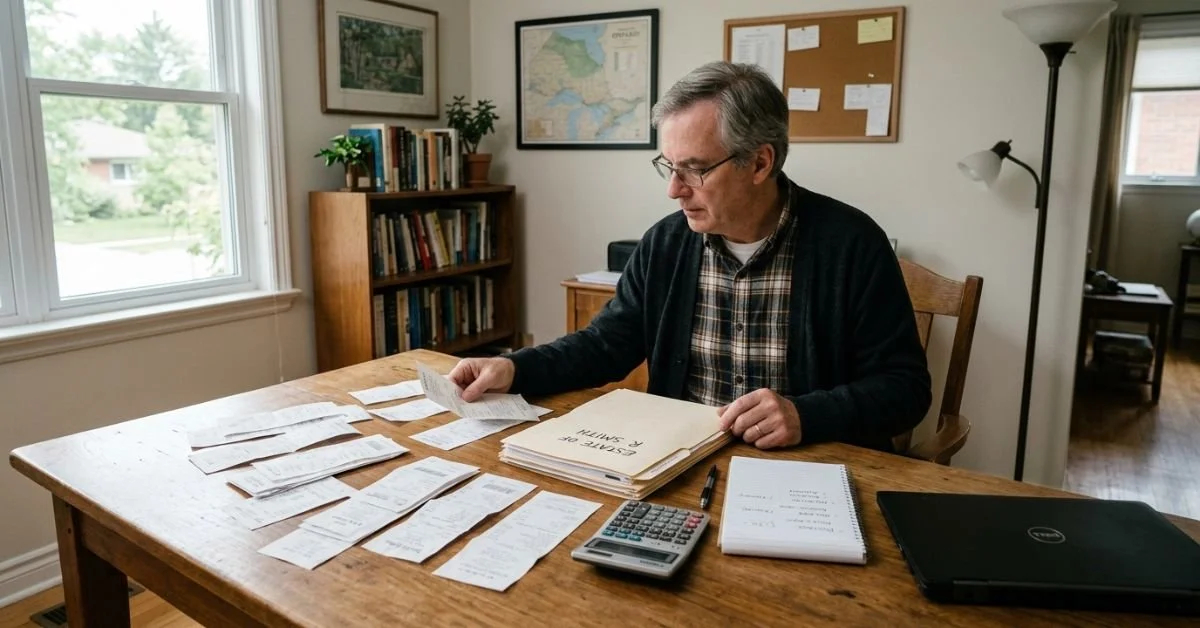
An Ontario estate trustee is entitled to be reimbursed out of the estate for expenses properly incurred in administering it. That entitlement is separate from compensation and works differently. Reimbursement returns money the estate trustee actually spent on the estate's behalf, so it puts them back where they started and is not income in their hands. Compensation is payment for the time, care and trouble of doing the job, is subject to a different standard, and is taxable. Confusing the two is what produces disallowed claims on a passing of accounts. This article sets out what is reimbursable, what is not, how the tax treatment differs, and what records make a claim defensible.
What Is the Difference Between Reimbursement and Compensation?
| Reimbursement of expenses | Compensation | |
|---|---|---|
| What it pays for | Money the estate trustee actually spent on the estate | The estate trustee's time, care, pains and trouble |
| Basis | The expense was properly incurred in the administration | Trustee Act section 61(1), a fair and reasonable allowance |
| Requires approval | No, where the expense is proper and documented | Yes, unless the will itself fixes or authorises it, failing which by the beneficiaries' consent or by the court |
| Tax treatment in the recipient's hands | Not income | Taxable income |
| Evidence needed | Receipts and a record of the purpose | Records of the work done and the value of the estate |
The governing principle is that an estate trustee should be no worse off and no better off. Reimbursement returns them to where they were. Anything beyond that is compensation, and compensation has its own rules.
Compensation under section 61(1) of the Trustee Act is a fair and reasonable allowance and the statute contains no formula. Ontario practice generally works from a percentage tariff as a starting point, subject to a check against a set of factors going to the size, difficulty and care of the administration. Section 61(5) disapplies the section where the instrument itself fixes compensation, and a direction that compensation is "to be agreed" does not fix it.
Compensation is taxable in the recipient's hands. That is a reason to address compensation in the will while the testator is alive, for example by fixing it or by leaving a gift expressly in place of compensation. It is not a licence to relabel remuneration after the death. An estate trustee cannot recharacterise payment for services as an inheritance to avoid income tax, because changing the label does not change what the payment is for. A genuine testamentary gift that is independent of services is a different thing, and is treated differently. Our client guide to the tax treatment of executor fees in Ontario covers that analysis.
Reimbursement is unaffected by any of that. It is a return of the estate trustee's own money rather than payment for services, and it stands whether or not compensation is ever claimed.
What Expenses Can Be Claimed Back?
Costs of the application and the court process. Court filing costs, the Estate Administration Tax deposit if the estate trustee paid it personally, bond premiums, notarial and commissioning fees, and the cost of certified copies.
Professional fees. Legal fees for the probate application and the administration, accounting fees for the final and estate returns, valuations and appraisals. These are ordinarily billed to the estate directly rather than advanced personally, which is generally the better arrangement.
Property costs. Insurance on estate real property, utilities, heating to prevent damage to a vacant home, property taxes, lawn and snow maintenance, security, cleaning, storage of contents, and repairs required to preserve or sell the property.
Funeral and burial expenses, where the estate trustee paid them personally. These rank first among the estate's debts, so a properly incurred funeral account paid out of pocket is recoverable ahead of other creditors.
Travel and mileage genuinely incurred for the estate: attending the property, the courthouse, the bank, the lawyer, or a valuation. Where travel is substantial, keep a contemporaneous log of dates, destinations, purpose and distance.
Administrative costs. Postage, courier, registered mail, photocopying, the cost of publishing a notice to creditors, searches, and long-distance calls.
Accommodation and meals where an out-of-town trip is genuinely necessary for the estate, at a reasonable rather than an indulgent standard.
Interest or carrying costs where the estate trustee had to borrow to fund an estate expense, though this is better avoided by having the estate pay directly.
What Cannot Be Claimed?
The estate trustee's own time. Time is compensation, not an expense. An estate trustee who bills the estate at an hourly rate for their own hours, without an entitlement fixed by the will, the agreement of the beneficiaries, or court approval, will have it disallowed.
Lost wages or vacation days. Taking time off work to administer the estate is part of the burden that compensation addresses.
Expenses that were not necessary. A first class flight where an economy ticket would have done, or a hotel materially above a reasonable standard, will be reduced rather than allowed in full.
The personal portion of a mixed expense. A receipt covering both estate and personal spending can still support reimbursement of the estate portion, provided that portion is properly identified and documented. What is not reimbursable is a personal share that has not been separated out.
Costs of the estate trustee's own misconduct. Where litigation arises from a breach of duty, the estate trustee generally bears those costs personally.
Anything that was not properly incurred for the estate. The test is whether the expenditure was properly incurred on the estate's behalf, not whether the person had formally taken office when they paid it. Someone who pays a reasonable funeral account and then renounces may still have a claim for that expense. What they cannot do is charge the estate for costs that were never the estate's to bear. A person who has intermeddled in the estate may also have difficulty renouncing at all, which is a separate problem.
Anything the will excludes. A will can restrict or condition what an estate trustee may recover.
How Do You Make the Claim Properly?
Have the estate pay directly wherever possible. Professional fees, insurance premiums and property costs are better invoiced to the estate than advanced personally. It avoids the claim entirely and keeps the record clean.
Open the estate account early so there is somewhere for those payments to come from.
Keep every receipt, with the purpose recorded on it. A receipt without a note of what it was for is a receipt that gets questioned two years later.
Keep a contemporaneous log of mileage and of anything not evidenced by a receipt.
Never pay estate expenses from a personal account without recording it. Commingling is the source of most disallowed claims.
Reimburse yourself from the estate account, with a clear entry describing the expense, rather than by informal offset against a distribution.
Tell the beneficiaries. Expenses disclosed as they are incurred draw few objections. Expenses that surface for the first time in the final accounts frequently do.
Everything appears in the accounts. Where accounts are passed, disbursements are set out in court format and can be objected to. Our guide to passing of accounts in Ontario explains the process and when it becomes necessary.
Costs on a passing of accounts are discretionary. They are in the court's discretion and are not automatically borne by the estate, which is another reason to keep the disbursement record defensible from the beginning.
Where This Goes Wrong
No receipts. The most common reason a legitimate expense is disallowed. The estate trustee bears the burden of justifying disbursements.
Billing time as an expense. Time is compensation, and compensation requires an entitlement fixed by the will, the beneficiaries' agreement, or court approval.
Paying from a personal account and reconstructing later. Reconstruction from memory and bank statements is far weaker evidence than a contemporaneous record.
Taking reimbursement by informal offset. Deducting expenses from a beneficiary's distribution rather than paying them out of the estate account obscures both entries.
Claiming expenses that benefited the estate trustee personally. Occupying an estate property, using an estate vehicle, or running personal errands alongside estate ones all invite scrutiny.
Surprising beneficiaries at the end. Disclosure as you go converts most disputes into non-events.
Reimbursing yourself before the estate can afford it. Expenses rank as costs of administration, which come after reasonable funeral expenses, but they still come before beneficiaries. In an estate that may not be solvent, taking reimbursement early is a decision to take advice on.
Reimbursement is straightforward when the record is clean and contentious when it is not, and the difference is almost entirely made in the first few months. If you are unsure whether something is properly an estate expense, that is a quicker question to ask now than to defend later. You can book a free call.
Frequently Asked Questions
Can an executor be reimbursed for expenses in Ontario?
Yes. An estate trustee is entitled to be reimbursed out of the estate for expenses properly incurred in administering it, including court costs, professional fees, property carrying costs, travel and administrative disbursements, supported by receipts.
Is executor reimbursement the same as executor compensation?
No. Reimbursement returns money the estate trustee actually spent, and is not income in their hands. Compensation pays for their time, care and trouble under section 61(1) of the Trustee Act, requires an entitlement fixed by the will or, failing that, the beneficiaries' consent or court approval, and is taxable income.
Can an executor charge for their time?
Not as an expense. Time is addressed through compensation, which requires either an entitlement fixed by the will, the agreement of the beneficiaries, or approval by the court on a passing of accounts.
Can an executor claim mileage in Ontario?
Travel genuinely incurred for the estate is a proper expense. Keep a contemporaneous log recording dates, destinations, purpose and distance, because mileage claims without a record are the ones that get reduced.
Who pays the executor's expenses if the estate has no money?
Expenses rank as costs of administration, which come after reasonable funeral expenses but before beneficiaries. Where the estate is insolvent there may not be enough to cover them, which is why an estate trustee should avoid advancing personal funds into an estate whose solvency is uncertain.
Do beneficiaries have to approve the executor's expenses?
Approval is not required for a proper and properly documented expense in the way it is for compensation. Beneficiaries can object to disbursements when accounts are passed, so disclosing expenses as they are incurred is the practical way to avoid a dispute at the end.
This article provides general information about Ontario law and is not legal advice. Speak with a lawyer about your specific circumstances.