
Multiple Wills in Ontario: How a Secondary Will Cuts Probate Tax
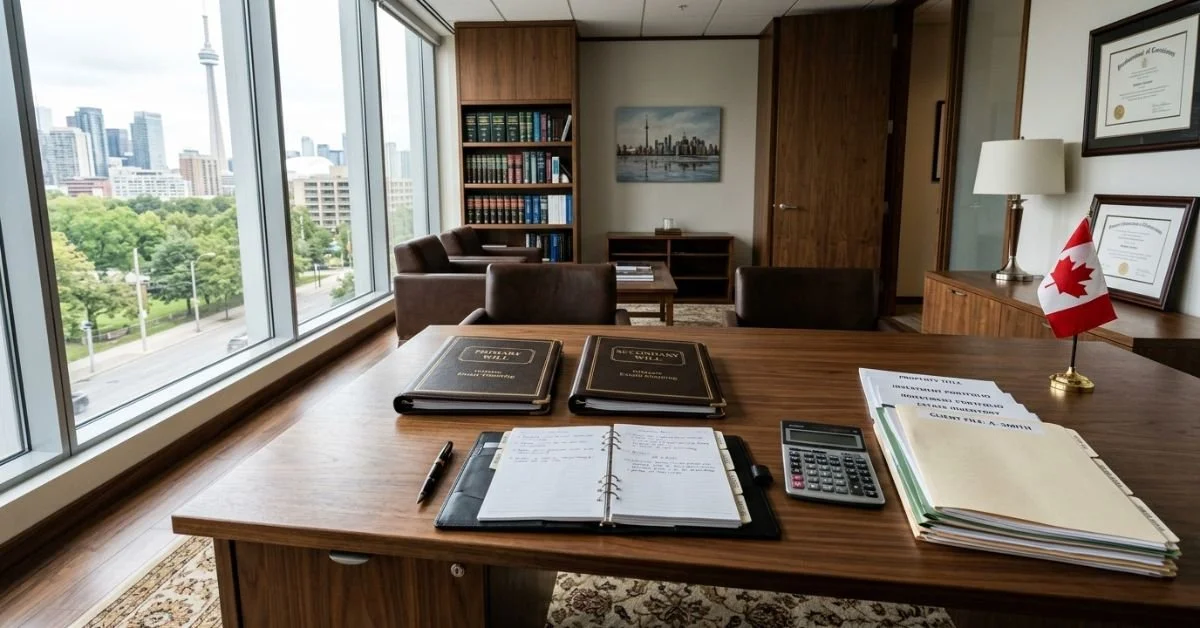
A person can make two wills in Ontario. A primary will covers assets that need a certificate of appointment before they can be transferred, and it is submitted for probate. A secondary will covers assets that can be transferred without one, such as private company shares, and it is not submitted. Estate Administration Tax is charged only on the value passing under the will that is probated, so the value in the secondary will is never included in the calculation. Once the probated estate already exceeds $50,000, each additional $1,000,000 kept outside probate saves $15,000. In the worked example below, keeping $2,000,000 of secondary will assets out of the probated estate therefore saves $30,000.
Why Does This Work?
Estate Administration Tax is charged on the value of the estate governed by the will submitted for probate. It is not charged on everything the deceased owned. Where a will is never submitted, the assets it governs never enter the calculation.
Some assets do not need probate to be transferred. A bank will generally not release a substantial account without a certificate. A land registry office will generally not register a transfer without one. But the directors of a private corporation, dealing with a shareholder whose family and lawyer they know, do not usually require a court certificate before recording a transmission of shares. The same is often true of shareholder loans, personal effects, and interests in a family partnership.
The strategy simply matches the will to the asset. Assets that require a certificate go in the primary will, which is probated. Assets that do not go in the secondary will, which is not. Both wills are valid testamentary documents and both take effect on death. Our guide on whether you need probate in Ontario if there is a will explains which assets fall on which side of that line.
What Does It Actually Save?
Consider an owner of a private corporation with $2,000,000 in company shares and $1,000,000 in other assets that require probate.
| Single will | Primary and secondary wills | |
|---|---|---|
| Value submitted for probate | $3,000,000 | $1,000,000 |
| Estate Administration Tax | $44,250 | $14,250 |
| Value in the secondary will | Not applicable | $2,000,000 |
| Tax on the secondary will | Not applicable | $0 |
The saving is $30,000, which is 1.5% of the value kept out of the probated estate. The arithmetic scales directly once the probated estate is already above the $50,000 exemption: every additional million dollars in the secondary will saves a further $15,000. The exemption is only available once, so an estate whose entire probated value would have been $2,000,000 pays $29,250 rather than $30,000, and the saving from removing all of it would be that lower figure.
There is a second benefit that has nothing to do with tax. A will submitted for probate becomes part of the court record. A secondary will does not, so the terms on which a business passes to the next generation stay private. For some business owners this matters more than the money. Our Estate Administration Tax guide sets out the calculation, and there is a calculator on our homepage.
Which Assets Go in Which Will?
| Typically in the primary will | Typically in the secondary will |
|---|---|
| Real property registered in the deceased's sole name | Shares in a private or professional corporation |
| Bank and investment accounts held solely | Shareholder loans owed by the corporation |
| Registered plans with no beneficiary designation | Personal effects, art and household contents |
| Vehicles requiring a transfer of registration | Interests in a family partnership or joint venture |
| Anything an institution will not release without a certificate | Amounts owed to the deceased by family members |
Allocation is not always obvious, and it is not something to guess at. Whether a particular asset can be transferred without a certificate depends on who holds it and what they will accept, which is a question about institutions rather than a question of law.
What Happened in the Milne Litigation?
The strategy went through a genuine period of uncertainty between 2018 and 2019, and material published during it is still in circulation.
The strategy was confirmed in 1998. In Granovsky Estate v. Ontario, the Superior Court confirmed the validity of using primary and secondary wills to limit the amount of probate tax payable. Multiple wills became standard practice for Ontario business owners after that decision.
In September 2018 the Superior Court held two primary wills invalid. In Milne Estate (Re), 2018 ONSC 4174, the court considered wills using an allocation clause, sometimes called a basket clause, which left it to the estate trustees to decide which assets required a certificate and to allocate accordingly. The judge held that a will is a form of trust and must satisfy the three certainties, and that the clause failed for uncertainty of subject matter.
In November 2018 a different judge declined to follow it. In Panda Estate (Re), 2018 ONSC 6734, the court held that a will is not a trust, does not require certainty of subject matter to be valid, and that the validity of an allocation clause is a matter of construction rather than something to be decided at the probate stage.
In January 2019 the Divisional Court allowed the appeal in Milne. Milne Estate (Re), 2019 ONSC 579, held that the application judge had exceeded his jurisdiction by examining the essential validity of the will at the probate stage, and confirmed Granovsky.
The result is that multiple wills, including those with allocation clauses, remain a valid Ontario planning technique. The episode did leave drafting practice more careful: describing the secondary will assets specifically, and using an allocation clause as a catch-all rather than as the primary mechanism, is the safer approach.
Where This Goes Wrong
Revocation clauses that cancel each other. A standard will begins by revoking all previous wills. Two standard wills executed in sequence means the second revokes the first. Both documents need revocation language drafted to leave the other standing, and it is among the most consequential drafting errors in this area.
Naming different estate trustees without thinking it through. It is possible, and sometimes desirable, but it creates two sets of fiduciaries who must cooperate over shared liabilities.
Assuming the secondary will is free of tax. It is free of Estate Administration Tax. The deemed disposition on death under section 70(5) of the Income Tax Act applies to private company shares exactly as it applies to anything else, and the capital gain on a successful business can be far larger than the probate tax saved.
Leaving the wills unreviewed after a corporate reorganisation. A share freeze, an amalgamation or a new holding company can leave the wills describing assets that no longer exist.
Using the structure where there is nothing to put in the secondary will. For an estate consisting of a house, bank accounts and registered plans, there is no meaningful saving, because those assets need the certificate anyway.
Executing them in the wrong order or on the same day without care. Sequence and dating matter, and the documents should be executed as a matched pair.
If you own a corporation, or are the estate trustee of someone who did, the question of whether multiple wills apply is worth a short conversation. You can book a free call to work through it.
Frequently Asked Questions
Are multiple wills legal in Ontario?
Yes. The Superior Court confirmed the technique in Granovsky Estate v. Ontario in 1998, and the Divisional Court reaffirmed it in Milne Estate (Re), 2019 ONSC 579, after a 2018 decision briefly put allocation clauses in doubt.
How much probate tax does a secondary will save in Ontario?
The Estate Administration Tax is $15 for each $1,000 or part of $1,000 above the $50,000 exemption. Where the probated estate already exceeds $50,000, each additional $1,000,000 kept outside probate saves $15,000, so $2,000,000 in a secondary will saves $30,000. The exemption applies only once, so if that $2,000,000 would have been the entire probated estate the tax avoided would be $29,250.
What is an allocation clause or basket clause?
It is a clause allowing the estate trustees to determine which assets require a certificate of appointment and to allocate them to the primary or secondary will accordingly. Its validity was challenged in the Milne litigation and upheld on appeal, and careful drafting now tends to describe the secondary will assets specifically and use the clause as a catch-all.
Do you need probate for private company shares in Ontario?
Often not, because the corporation itself records the transmission of shares and is not usually a third party that requires court confirmation of the estate trustee's authority. That is precisely why private company shares are the classic secondary will asset. A shareholders agreement or a corporate lender can change the answer.
Can multiple wills be used for real estate?
Generally not. A land registry office requires a certificate of appointment before registering a transfer out of a deceased owner's name, so real property normally belongs in the primary will. The first dealings exemption is a separate mechanism that can remove some Land Titles property from the probate requirement entirely.
Does a secondary will need to be probated later?
Not ordinarily. It takes effect on death like any other will, and the estate trustee deals with the assets it governs without a certificate. If a third party later insists on a certificate for one of those assets, the secondary will can be submitted at that point, and the tax would then apply to what is covered.
This article provides general information about Ontario law and is not legal advice. Speak with a lawyer about your specific circumstances.