
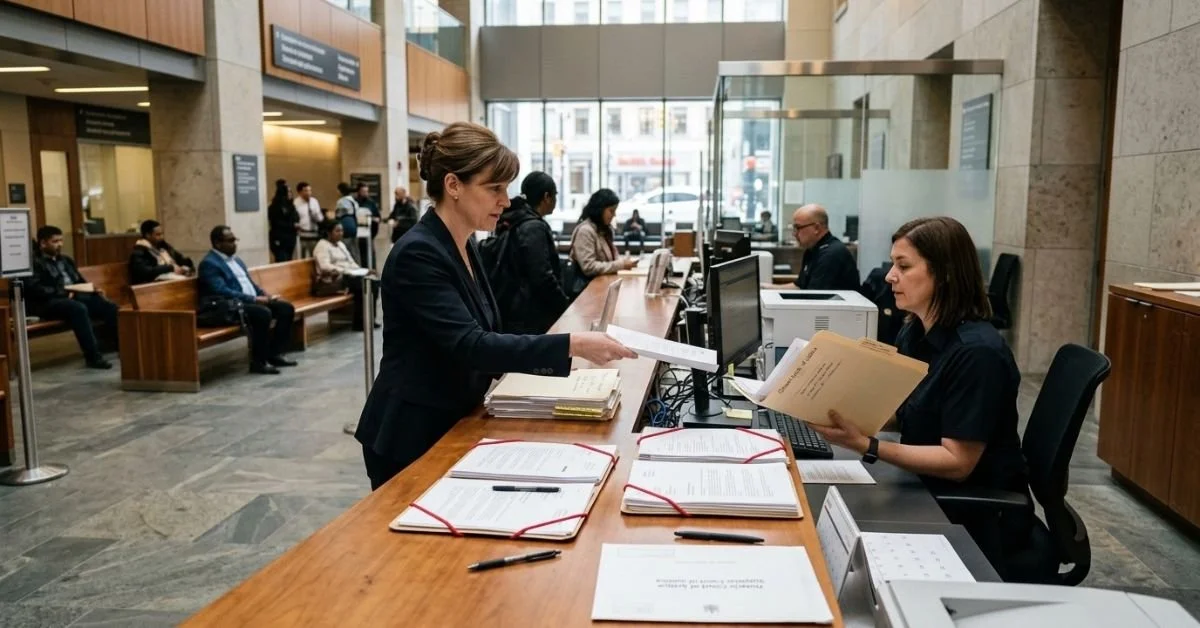
Probate applications for people who lived in Ottawa at the time of death are filed with the Superior Court of Justice at the Ottawa Courthouse, 161 Elgin Street, 2nd Floor, Ottawa, Ontario K2P 2K1. Ottawa sits in the East Region of the Superior Court. You do not have to attend in person: filing by email is available for both the regular and the small estate streams under the Superior Court of Justice Consolidated Civil Provincial Practice Direction, and the certificate is emailed back. This guide covers which estates belong in Ottawa, how to file, what the building actually contains that matters to an executor, and the issues that are specific to estates in this city.
Which Estates Are Filed in Ottawa?
The rule is residence at death, not where the family lives. A probate application goes to the court for the place where the deceased lived at the time of death. If the deceased was not an Ontario resident, it goes to the place where their Ontario property is located.
That produces answers people find counterintuitive. An executor living in Ottawa whose parent lived in Kingston files in Kingston. A deceased Ottawa resident whose three children all live in Toronto is still an Ottawa filing.
Residence after a move into long-term care is fact-specific. A person who kept an Ottawa home while spending their final months in a care residence elsewhere may still have been an Ottawa resident. Where the answer is genuinely unclear, it is worth settling before filing, because filing in the wrong location is not correctable by amendment.
| Ottawa filing at a glance | |
|---|---|
| Court | Superior Court of Justice, East Region |
| Address | Ottawa Courthouse, 161 Elgin Street, 2nd Floor, Ottawa, Ontario K2P 2K1 |
| Who files here | Estates of people who lived in Ottawa at the time of death |
| Regular stream | Form 74A, any value, service before filing |
| Small estate stream | Form 74.1A, $150,000 or less, notice at least 30 days before filing |
| Filing method | By email under the Consolidated Civil Provincial Practice Direction, or in person |
| Languages | English and French |
| Land registry | Ottawa-Carleton LRO shares the address, but searches and registrations are online |
Ottawa serves the City of Ottawa. Residents of neighbouring counties in Eastern Ontario file in the court for the place they lived, which is not necessarily the nearest large courthouse. Our courthouse guide by region sets out the routing rule and the main estates offices across the province.
How Do You File?
Determine which certificate you need. The regular stream uses Form 74A and applies at any value. The small estate stream uses Form 74.1A and is available where the estate is $150,000 or less.
Serve everyone entitled to a share before filing on the regular stream, and at least thirty days before filing on the small estate stream. Our guide to the Small Estate Certificate explains the notice requirement and when the fast track is genuinely faster.
Assemble the supporting material. The original will, proof of execution, proof of service, and any bond or renunciation the application requires.
Calculate the Estate Administration Tax and prepare the deposit. Nil on the first $50,000, then $15 per $1,000 or part of $1,000 above that, on a value rounded up to the nearest $1,000.
File by email or in person, and send the originals separately. The application and supporting documents can be filed by email for both streams under the Consolidated Civil Provincial Practice Direction. Email does not complete the filing on its own: original documents, including the will, any codicils, administration bonds and ancillary certificates, and any certified copies, must still be delivered in paper to the court office in person or by mail or courier. The Estate Administration Tax payment must also be delivered in person or sent by mail or courier. The certificate itself is then issued electronically and emailed back.
Respond promptly to any registrar's notice. Ontario's guidance is that regular applications are typically processed within about fifteen business days and small estate applications within about five, with both taking longer where documents or evidence are missing.
If you do attend in person, plan for the building. The Elgin Street courthouse is a large multi-storey complex with a single public entrance and security screening, and counter services operate on limited hours rather than throughout the day. Parking under the adjacent City Hall is generally the practical option. Confirm current counter hours before travelling, because they change.
Services are available in English and French at the Ottawa courthouse, which matters in a city where a substantial share of estates involve francophone families and bilingual documentation.
What Is Different About Ottawa Estates?
Land registry work is electronic, not counter work. The Ottawa-Carleton Land Registry Office is associated with the same Elgin Street address, but do not plan a trip around it. Ontario land registry services are delivered online: title searches run through OnLand, and registrations go through the electronic land registration system. Where an estate includes Ottawa real property, the title search that confirms how the property is held is done online and can proceed in parallel with the probate application rather than after it.
Federal public service pensions appear constantly. Ottawa estates routinely include a federal public service pension, superannuation, or a Government of Canada death benefit. These are administered federally, have their own survivor benefit processes, and are separate from the estate. A survivor benefit payable to a spouse does not form part of the estate and is not included in the Estate Administration Tax calculation. A lump sum payable to the estate is. The distinction has to be established rather than assumed, because it changes both the probate tax and who is entitled.
Quebec property is common and is treated separately. A great many Ottawa residents own property across the river. Real property outside Ontario is excluded from the Estate Administration Tax calculation and is dealt with under the law of the place where the land sits, so an estate holding a Gatineau condominium or a Pontiac cottage generally needs a parallel process in Quebec, a civil law jurisdiction with its own succession procedures. Personal property held across the river raises a different question, turning on recognition and resealing rules rather than automatically on a separate administration.
Cross-border employment and residence questions. People who worked in Ottawa and lived in Quebec, or the reverse, generate residence questions that affect both where the application is filed and which tax rules apply.
How Long Does It Take?
The court's part is the shorter part. Ontario's guidance is that regular applications are typically processed within about fifteen business days, and small estate applications within about five. The small estate stream is therefore faster once filed, although its thirty-day pre-filing notice requirement means the route can still be slower end to end.
The administration is the longer part. Ontario estates commonly run twelve to eighteen months from death to final distribution, and the court certificate is an early step in that period rather than the end of it. Our guide to how long probate takes in Ontario sets out the full timeline.
What actually causes delay is a deficient application, an objection filed against the application, a property that has to be sold before the estate can be settled, or the wait for a Canada Revenue Agency clearance certificate.
Contested matters take a different path. A notice of objection stops the certificate until it is resolved or removed, and the application then proceeds under the contentious estates rules rather than over the counter.
Where This Goes Wrong
Filing where the executor lives. The deceased's residence at death governs. This is the most common location error and it costs a full refiling.
Assuming an out-of-province property is covered. Real property outside Ontario is generally dealt with under the law and succession process of the jurisdiction where the land is situated. Personal property outside Ontario can raise different recognition or resealing rules rather than automatically requiring a wholly separate administration.
Including a federal survivor pension in the estate value. A benefit payable directly to a surviving spouse does not pass through the estate. Including it inflates the Estate Administration Tax deposit.
Attending the counter without checking hours. Counter services operate on restricted hours, and email filing removes the trip entirely for both streams.
Treating the small estate route as automatically quicker. Processing is faster once filed, at about five business days against fifteen, but the thirty-day notice period runs before filing, so end to end it can still take longer than the regular stream.
Waiting for the certificate before doing anything else. Securing property, arranging insurance on a vacant home, and gathering asset information all proceed before the certificate arrives.
B.I.G. Probate Law Group is based in Toronto, at First Canadian Place, 100 King Street West, Suite 5700, and serves clients across Ontario, including Ottawa. Email filing means the location of your lawyer no longer determines where an application can be filed. You can book a free call to talk through an Ottawa estate. Ask us whether you qualify for our Fixed-Fee Probate Service and No-Surprise Pricing Guarantee.
Frequently Asked Questions
Where do you file a probate application in Ottawa?
With the Superior Court of Justice at the Ottawa Courthouse, 161 Elgin Street, 2nd Floor, Ottawa, Ontario K2P 2K1, where the deceased lived in Ottawa at the time of death. Filing by email is available for both the regular and small estate streams.
Do you have to live in Ottawa to file there?
No. What matters is where the deceased lived at the time of death. An executor anywhere in Ontario, or outside it, files in the court for the deceased's place of residence.
Can you file for probate in Ottawa by email?
Yes, for the application and supporting documents, under the Superior Court of Justice Consolidated Civil Provincial Practice Direction, and the certificate is returned by email. Original wills and other original supporting documents, including codicils, bonds, ancillary certificates and certified copies, along with the Estate Administration Tax payment, must still be delivered separately in person or by mail or courier.
How long does probate take in Ottawa?
Ontario's guidance is that regular applications are typically processed within about fifteen business days and small estate applications within about five, and that both take longer where documents or evidence are missing. The wider administration commonly runs twelve to eighteen months from death to final distribution.
What happens if the deceased owned property in Quebec?
Real property outside Ontario is excluded from the Ontario Estate Administration Tax calculation and is dealt with under the law of the jurisdiction where the land is situated, so a parallel process in Quebec is generally required for Quebec land. Personal property is a different question, and can turn on recognition or resealing rules rather than on a wholly separate administration.
Does a federal public service survivor pension form part of the estate?
A survivor benefit payable directly to a surviving spouse does not pass through the estate and is not included in the Estate Administration Tax calculation. A lump sum payable to the estate is. Which applies depends on the plan and the designation, so it should be confirmed rather than assumed.
This article provides general information about Ontario law and is not legal advice. Speak with a lawyer about your specific circumstances.