
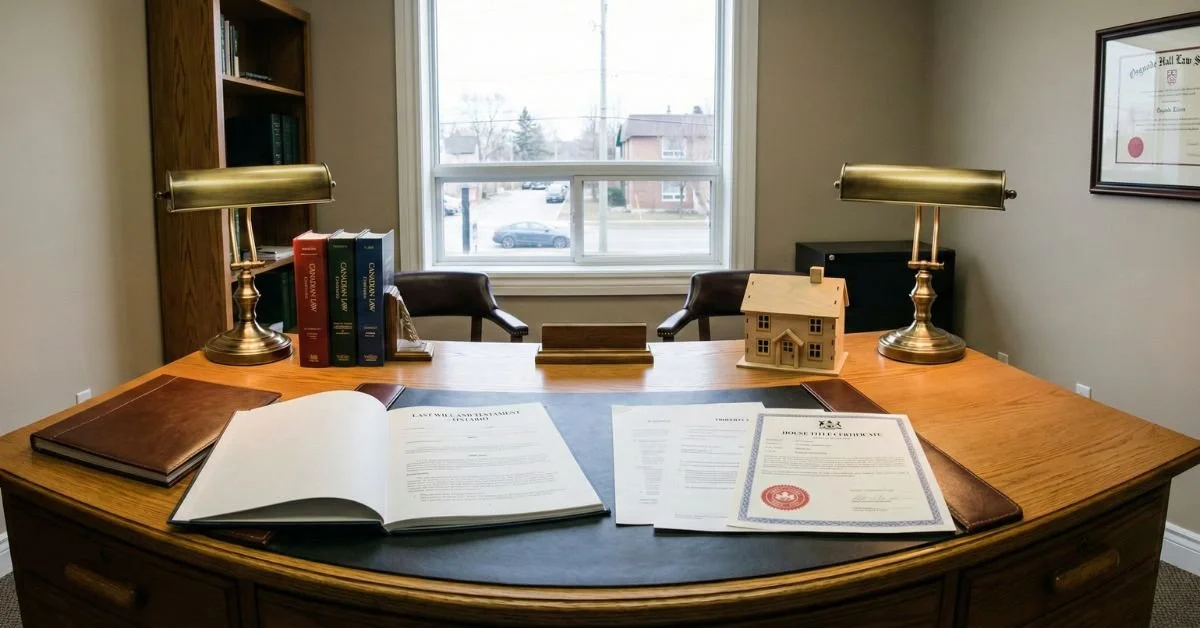
When someone dies in Ontario, their property needs to be transferred to the rightful beneficiaries or surviving owners.
The process of transferring property after death with a will in Ontario involves probate, title transfers through the Land Titles Office, and payment of applicable fees and taxes. The exact steps depend on how the property was owned.
Understanding this process helps executors and beneficiaries manage the transfer correctly and avoid common mistakes.
The way property transfers after death depends largely on the type of ownership.
Joint tenants follow a different process than sole owners or tenants in common. Each situation has its own legal requirements and timelines.
This guide explains the key steps for transferring property after death in Ontario when a will exists.
It covers the probate process, different ownership types, legal requirements, and practical actions needed to complete the transfer properly.
Overview of Property Transfer After Death in Ontario
When someone dies in Ontario, their property transfers to beneficiaries through a legal process governed by estate law.
The type of ownership and whether a valid will exists determines how quickly and smoothly this transfer happens.
Role of a Will in Property Transfer
A will is a legal document that names who receives the deceased person's assets and appoints an executor to manage the estate.
In Ontario, a valid will provides clear instructions for property transfer and prevents the estate from being divided according to intestacy laws.
The executor uses the will to identify beneficiaries and distribute property rights accordingly.
This includes real estate, bank accounts, investments, and personal belongings.
Financial institutions and the land registry require either a probated will or other legal proof before transferring property ownership to new owners.
A properly prepared will reduces delays in the transfer process and helps prevent family disputes by removing uncertainty about who inherits specific assets.
Without a will, Ontario's Succession Law Reform Act determines how property gets divided among surviving family members.
Sole Ownership Versus Co-Ownership
Property ownership structure affects the transfer process after death.
Sole ownership means one person holds complete title to the property.
When a sole owner dies, their property becomes part of the estate and transfers according to their will or intestacy laws.
Co-ownership comes in two forms: joint tenancy and tenancy in common.
Joint tenancy includes the right of survivorship, which means the surviving owner automatically receives the deceased owner's share without probate.
The property transfers directly and does not pass through the will.
Tenancy in common works differently.
Each owner holds a separate share that becomes part of their estate when they die.
These shares transfer through the will to named beneficiaries rather than to the other co-owners.
Key Legal Principles and Terms
Several legal principles guide property transfer in Ontario estate law.
The executor or estate trustee holds authority to manage the deceased's assets during the administration period.
This person handles debts, taxes, and the distribution of property to beneficiaries.
Probate refers to the court process that validates a will and grants the executor legal authority to act.
The Certificate of Appointment of Estate Trustee With a Will serves as official proof of the executor's authority to complete real estate transactions.
Estate Administration Tax applies to most estates valued over $50,000.
The rate is 1.5% on the amount exceeding this threshold.
This tax must be paid before property ownership can transfer to beneficiaries through the land registry system.
Types of Property Ownership and Impact on Transfer
In Ontario, the type of property ownership determines how a property transfers after death.
Joint tenants benefit from automatic transfer to survivors, while tenants in common pass their share through their estate according to their will.
Joint Tenancy and Right of Survivorship
Joint tenancy occurs when two or more people own property together with equal ownership shares.
The key feature of this arrangement is the right of survivorship, meaning when one joint tenant dies, their share automatically transfers to the surviving joint tenant.
This transfer happens outside the estate and does not go through probate.
The will does not control what happens to it.
For example, if two people own a property as joint tenants with 50% each, when one dies, the survivor automatically owns 100%.
To complete the transfer, the surviving joint tenant works with a real estate lawyer to file a Survivorship Application.
This application removes the deceased's name from the property title at the Land Titles Office.
The process is simpler and faster than probate.
Key characteristics of joint tenancy:
Equal ownership shares for all joint owners
Automatic transfer to surviving owner
No probate required
Will does not affect the property transfer
Right of survivorship cannot be changed by will
Tenants in Common and Inheritance Rules
Tenants in common means two or more people own property together, but each co-owner holds a distinct share.
Unlike joint tenancy, there is no right of survivorship.
When a tenant in common dies, their share does not automatically go to the other co-owners.
The deceased's share becomes part of their estate.
The will determines who inherits this portion of the property.
If there is no will, Ontario's intestacy laws decide who receives it.
Ownership shares do not need to be equal.
One co-owner might hold 70% while another holds 30%, depending on how much each person invested.
These percentages matter during transfer because each share has a different value.
The executor must obtain probate to transfer a tenant in common share.
The property title shows each owner's percentage, and that specific share transfers according to the will.
The new owner becomes a tenant in common with the remaining co-owners.
Sole Owner Property Considerations
Sole ownership means one person holds the property title entirely in their name.
When a sole owner dies, the property becomes part of their estate and transfers according to their will.
The executor named in the will must apply for probate to gain legal authority over the property.
After receiving the Certificate of Appointment of Estate Trustee, the executor can transfer the property title to the beneficiary named in the will.
If the will leaves the property to multiple people, they become either joint tenants or tenants in common, depending on the will's wording.
The executor registers the transfer with the Land Titles Office and pays any required land transfer taxes.
Steps for sole owner property transfer:
Executor applies for probate
Court issues Certificate of Appointment
Executor prepares transfer documents
Transfer registered at Land Titles Office
New owner receives updated property title
Transferring Property When Joint Tenants Are Involved
When property is held in joint tenancy with right of survivorship, the deceased's share transfers automatically to the surviving owner without going through probate.
The surviving joint tenant needs to complete a survivorship application to remove the deceased's name from the title and update the land registry records.
Survivorship Application Process
The survivorship application process allows a surviving joint tenant to officially transfer ownership after a co-owner's death.
A real estate lawyer typically prepares the survivorship application documents and submits them to the land registry office.
The application removes the deceased person's name from the property title.
The surviving owner must provide original government-issued documents to support the application.
Once the land registry office processes the application, the parcel register is updated to show only the surviving owner's name.
This process is faster and less expensive than probate because it does not require a certificate of appointment.
The transfer happens by operation of law, meaning ownership passes automatically when death occurs.
The survivorship application simply formalizes this transfer on the official records.
Documentation Requirements for Survivorship
The survivorship application requires specific documents to prove the death and confirm the survivor's identity.
A death certificate issued by the provincial government serves as proof of death.
The surviving owner must provide photo identification and documents showing their current address.
The original deed or land transfer documents showing joint tenancy ownership may be required.
The lawyer will also obtain a copy of the current parcel register from the land registry office to verify the property details and ownership structure.
All documents must be original or certified copies.
Additional identification documents may be needed depending on the specific circumstances of the transfer.
Exemptions and Spousal Status Considerations
Spousal status affects the tax treatment of property transfers in joint tenancy situations.
When a spouse is the surviving joint tenant, the property transfer is generally exempt from land transfer tax in Ontario.
A marriage certificate proves the spousal relationship for this exemption.
The property's fair market value must still be determined for estate reporting purposes, even though the transfer avoids probate.
Common-law spouses may qualify for similar exemptions if they meet Ontario's definition of spouse under family law.
Non-spousal joint tenants, such as adult children or business partners, may face different tax implications.
These transfers can trigger capital gains tax based on the deceased's share of the property's appreciated value.
Transferring Property Under a Will: Sole Owners and Tenants in Common
When a deceased person owned property solely or as a tenant in common, the estate trustee must obtain legal authority through probate before transferring the property to beneficiaries.
The transfer process requires specific documentation and follows structured steps through Ontario's legal system.
Probate and Certificate of Appointment of Estate Trustee
The estate trustee named in the will must apply for a Certificate of Appointment of Estate Trustee with a Will.
This document validates the will and grants legal authority to manage the estate's assets.
The probate application requires several documents.
The estate trustee must submit the original will, the death certificate, and completed court forms.
If any changes were made to the will through codicils, these must be included.
Estate administration tax must be paid when filing the application.
Estates valued up to $50,000 pay no tax.
For estates over $50,000, the tax is $15 per $1,000 of estate value, with a maximum rate of 1.5%.
The estate trustee must provide copies of the application to all beneficiaries before submission.
The court reviews the documents and issues the certificate if everything is in order.
This certificate proves the estate trustee has legal authority to transfer property and manage other estate assets.
Transfer by Estate Trustee
Once the certificate is obtained, the estate trustee handles all aspects of asset management and property transfer.
The trustee must first settle any outstanding debts related to the property, including mortgages, property taxes, and utility bills.
The estate trustee notifies financial institutions, government authorities, and any relevant parties about the death.
This ensures accounts are frozen or transferred appropriately.
To transfer the property title, the estate trustee files documents with the Land Titles Office.
The transfer documentation includes the Certificate of Appointment of Estate Trustee and completed transfer forms.
Title transfer fees apply for updating the official property records.
Transfer by Beneficiary
The beneficiary receiving the property must pay land transfer tax based on the property's value.
This tax applies even though the transfer occurs through estate administration rather than a typical sale.
The beneficiary becomes responsible for the property once the title transfer is complete.
The Land Titles Office updates the property records to reflect the new ownership.
If the deceased owned property as a tenant in common, only their specific percentage transfers through the will.
The other owners retain their existing shares.
For example, if the deceased held 30% ownership, only that portion passes to the beneficiary named in the will.
Legal and Financial Implications of Property Transfer
Transferring property after death in Ontario involves specific costs and legal requirements.
Understanding land transfer tax exemptions, property valuation rules, mortgage responsibilities, and legal professional fees helps executors budget properly and avoid unexpected expenses.
Land Transfer Tax and Filing Fees
Ontario does not charge land transfer tax when property transfers directly to a beneficiary through a will.
The tax only applies if the property is later sold to someone outside the family who is not named in the will.
However, executors must pay other fees during the transfer process.
The estate administration tax costs 1.5% on estate values over $50,000.
For example, an estate worth $500,000 pays about $6,750 in estate administration tax.
Filing fees for the probate application vary based on estate size.
Title registration fees apply when updating ownership records through Ontario's electronic land registration system.
These fees typically range from a few hundred to several thousand dollars depending on the complexity of the transfer.
Valuation and Handling of Mortgages
Properties must be valued at fair market value for estate administration purposes.
This valuation determines the estate administration tax owed and helps ensure fair distribution among beneficiaries.
Executors often hire professional appraisers to establish accurate values.
If the property has an outstanding mortgage, the executor must decide how to handle it.
The mortgage doesn't disappear when someone dies.
Options include paying off the mortgage from estate funds, having the beneficiary assume the mortgage payments, or selling the property to settle the debt.
Some estates lack enough liquid assets to cover mortgages and other debts.
In these cases, the executor may need to sell the property even if the will intended it to pass to a specific beneficiary.
Legal Professional Costs
A real estate lawyer must handle the property transfer in Ontario. Legal fees usually range from $2,000 to $10,000, depending on how complex the estate is.
Straightforward transfers cost less. Complicated situations with multiple heirs or disputes increase expenses.
Legal professionals prepare and file documents, update land registry records, and ensure all legal requirements are met. They also help resolve probate and title issues that may arise.
Executors should budget for legal fees early in the process. The estate pays these costs before assets are distributed to beneficiaries.
Practical Steps to Complete the Property Transfer
After the executor gets probate and settles the estate's debts, they can start transferring real property to beneficiaries. This involves specific documents and working with Ontario's land registration system.
Coordination with different institutions is needed to ensure the property title changes hands legally.
Gathering Documentation and Proof of Ownership
The executor needs several key documents before starting a property transfer. The original signed will is the main proof of ownership and transfer authority.
The Certificate of Appointment of Estate Trustee With a Will (probate certificate) confirms the executor's legal authority. The executor must also get the official death certificate and locate the property deed or title documents.
These documents establish the deceased's ownership interest in the real estate. The parcel register, which shows the property's legal description and registered ownership, is available through Ontario's land registry system.
The Affidavit of Execution confirms the will was properly signed and witnessed. If required, a clearance certificate from the Canada Revenue Agency may confirm all taxes have been paid.
Property tax statements and utility bills help verify the property address and account numbers. Keeping organized copies of all documents prevents delays.
The executor should create both physical and digital files to share with the real estate lawyer.
Dealing with the Land Registry Office
Ontario uses an electronic land registration system called ELRS. Executors cannot file directly with the Land Registry Office.
A licensed real estate lawyer must submit transfer documents through this system. The lawyer prepares a Transfer/Deed of Land form to move ownership from the deceased to the beneficiary.
This form references the probate certificate and the property's legal description from the parcel register. The property title is then updated to show the new owner.
Registration fees apply based on the number of properties transferred. The lawyer submits all documents electronically, and once approved, the beneficiary receives an updated parcel register as proof of ownership.
Notifying Financial and Government Institutions
The executor must inform several organizations about the property transfer. Mortgage lenders need notification if there is an outstanding mortgage, as the loan may need to be paid or assumed by the beneficiary.
Home insurance companies require updates to change the policyholder's name and keep coverage during the transfer. Property tax accounts must be updated with the municipality to reflect the new owner's information.
Utility providers like hydro, gas, water, and internet services need notification to transfer or close accounts. The executor should request final bills to settle from the estate before transferring services to the beneficiary.
The Canada Revenue Agency should be notified if the property generates rental income or if there are capital gains. Financial institutions holding the deceased's accounts may have placed holds on funds and need confirmation that estate administration is complete.
Conclusion
Transferring property after death in Ontario requires careful attention to legal steps and proper documentation. Executors and beneficiaries must navigate probate, settle debts, and complete title transfers at the Land Titles Office.
Understanding each requirement helps ensure a smooth transfer that honours the deceased's wishes. Professional legal guidance makes a significant difference when managing estate property transfers.
B.I.G. Probate Law Ontario specializes in helping families with these legal requirements. Our team provides support throughout the process.
Contact B.I.G. Probate Law Ontario for expert assistance with your property transfer needs. Book a free call to discuss your situation.
You can also reach us by phone at 437-525-1888 or email at welcome@probatelawgroup.ca. Visit our website at probatelawgroup.ca for more information about estate administration services in Ontario.
Frequently Asked Questions
Property transfer after death in Ontario involves legal processes and requirements that depend on the type of property ownership and whether there is a will. The following questions address common concerns about transferring property, probate requirements, and necessary documentation.
What is the best way to transfer property after death?
The best way to transfer property after death depends on how the property was owned. Joint tenancy with right of survivorship allows property to pass automatically to the surviving owner without probate.
This is often the simplest method. For properties held as tenants in common or solely owned, transferring through a will provides clear direction.
The executor named in the will manages the transfer process through probate when required. Planning ahead by establishing joint ownership or setting up the property title can help simplify the transfer for beneficiaries.
How is property transferred after death with a will in Ontario?
When someone dies with a will in Ontario, the executor must apply for probate to obtain a Certificate of Appointment of Estate Trustee with a Will. This certificate gives the executor legal authority to manage and distribute the deceased's assets.
The executor gathers required documents including the death certificate, the original will, and any amendments. They must also pay the estate administration tax when submitting the probate application.
Once probate is granted, the executor can transfer the property title through the Land Titles Office. The executor must settle any outstanding debts before transferring property to beneficiaries named in the will.
Can property be transferred without probate in Ontario?
Yes, property can be transferred without probate in some situations. If the deceased owned property as a joint tenant with another person, the property automatically passes to the surviving owner.
A real estate lawyer can prepare a survivorship application to remove the deceased's name from the property title. This process does not require probate court involvement.
Properties held as tenants in common cannot use this method. The deceased's share becomes part of their estate and usually requires probate for transfer.
Do you always need probate to transfer a house in Ontario?
No, probate is not always required to transfer a house in Ontario. Joint tenancy properties transfer through survivorship without probate.
Some properties may qualify for the First Dealings Exemption in the Land Titles Conversion Qualified system. This exemption allows certain transfers without probate if specific conditions are met.
Most solely owned properties or tenants in common arrangements require probate. Financial institutions and the Land Titles Office usually require proof of legal authority before allowing property transfers.
What documents are needed to transfer real estate after death?
The main documents needed include the deceased's death certificate and the original will, if one exists. The executor needs the Certificate of Appointment of Estate Trustee, obtained through probate.
Property-related documents include the current deed or title, property tax statements, and mortgage information if there is a loan. The executor must also provide court forms for the probate application.
Any amendments or codicils to the original will must be included. The Land Titles Office requires specific transfer forms to officially change the property ownership.
Can property be transferred without probate in Ontario if there is a will?
Property can be transferred without probate if it was held in joint tenancy. The right of survivorship overrides the will's instructions for that property.
The surviving joint tenant becomes the sole owner automatically upon death. A real estate lawyer can complete the title transfer through a survivorship application without probate.
If the property was held solely or as tenants in common, probate is usually required even with a valid will. The executor needs legal authority through probate to transfer the property.