
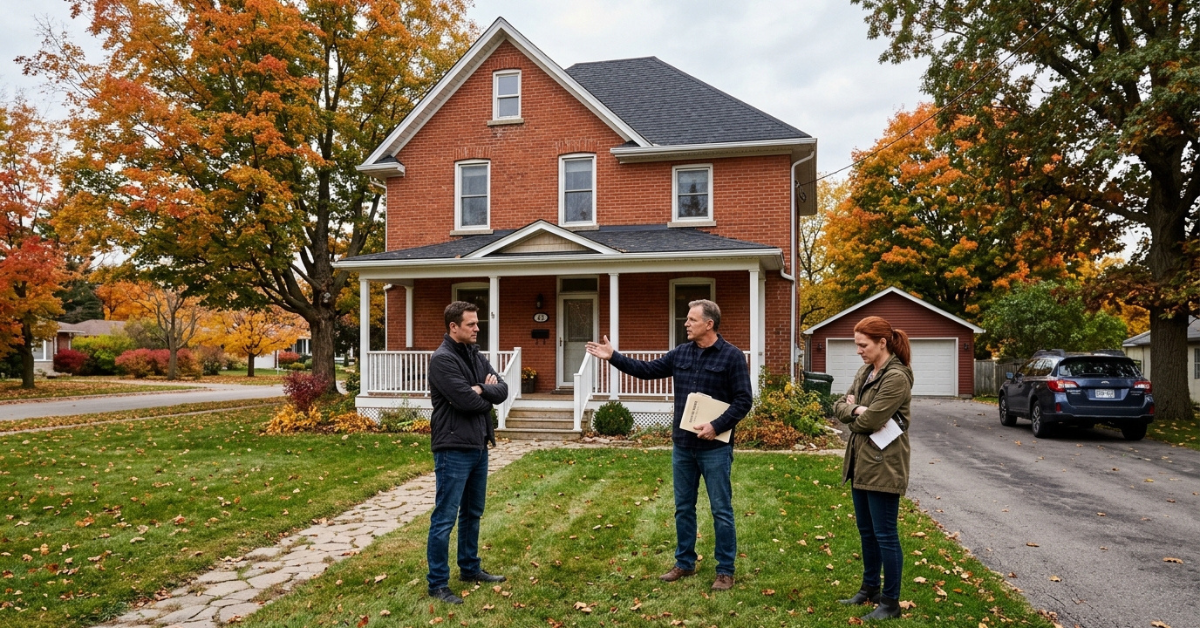
Where siblings inherit a house together and cannot agree what to do with it, Ontario's Partition Act gives any co-owner a presumptive right to apply to the Superior Court of Justice to compel a partition of the land or, far more commonly, a sale. Physical division of a residential property is generally not practical, so section 3 of the Act allows the court to order a sale where that would be more beneficial to the parties than a division, and that is the ordinary outcome. The right is strong: an application is refused only in narrow circumstances, principally where the applicant's motive is malicious, oppressive or vexatious. What changes the analysis completely is timing. Until the property has actually vested in the beneficiaries, the person who controls it is the estate trustee, and the Partition Act is not yet the relevant tool.
Who Actually Controls the House Right Now?
This is the first question and it decides everything that follows. Real property devolves to the personal representative for the purposes of administration, so during the administration the estate trustee holds it and deals with it, not the beneficiaries.
Where the will gives the estate trustee a power of sale, the trustee can sell without the beneficiaries' agreement, subject to their fiduciary duties. A beneficiary who wants the house kept cannot veto that, and a beneficiary who wants it sold applies pressure to the trustee rather than to the court under the Partition Act.
Section 9 of the Estates Administration Act provides that real property not disposed of, conveyed, divided or distributed within three years of death vests in the beneficiaries automatically, unless the estate trustee has registered a caution. Section 10 preserves powers conferred by the will, so an unrestricted power of sale coupled with a discretion to postpone conversion can prevent section 9 from forcing vesting at three years. The result depends on the wording of the will and the nature of the beneficiary's interest.
| Stage | Who decides | The relevant tool |
|---|---|---|
| Administration under way, will gives a power of sale | Estate trustee | Pressure on the trustee, or an application for directions |
| Administration under way, no power of sale | Estate trustee, more constrained | Application for directions; removal if the trustee is not acting |
| Property has vested in the beneficiaries as co-owners | The co-owners | Partition Act |
| Property was jointly held with a survivor | Depends on beneficial ownership | Survivorship, subject to a resulting trust analysis |
The last row catches people out. Where a parent added an adult child to title before death, the property does not automatically belong to that child. For an independent adult child the presumption of resulting trust applies, and the survivor may hold the interest for the estate. Our guide to joint ownership with right of survivorship sets out how that analysis works.
What Does the Partition Act Actually Allow?
The class of people who can apply is broad. Joint tenants, tenants in common, and parties interested in land in Ontario may be compelled to make or suffer a partition or sale. That language is wide enough to capture beneficiaries who have become co-owners of estate property.
A co-owner has a prima facie right to compel partition or sale. The court will grant the order unless there is a compelling reason not to, and the recognised reason is conduct: an application brought maliciously, oppressively, or with vexatious intent. A breakdown in trust among the parties, on its own, is not that. Courts have made the order despite plain hostility between the co-owners, because hostility is the reason the application exists.
Sale is ordered rather than partition in most residential cases, because dividing a house physically is not commercially feasible.
Two limits are worth knowing. The applicant needs a possessory right to the land. And where the property is occupied by tenants, the court must consider their rights and may structure the sale accordingly.
How Is a Buyout Priced?
A buyout is a negotiated purchase of the other co-owners' shares, and the argument is almost never about the concept. It is about three numbers.
The value. A date-of-death appraisal supports the estate value, but a buyout happening two years later is priced on current fair market value, not on the probate figure. Two appraisals are commonly needed, and each side should understand which one is doing which job.
The costs a sale would have incurred. A co-owner buying out the others is not paying a real estate commission, and the sellers frequently argue the price should reflect the full market value while the buyer argues it should reflect the net the estate would have received. There is no formula. It is negotiated.
The accounting between the co-owners. Who paid the mortgage, the property taxes, the insurance and the repairs since the death, and who lived there.
That third number is where occupation rent enters. A co-owner who has had exclusive use of the property may be asked to account for its rental value. It is an equitable and discretionary claim rather than an automatic entitlement, and it is frequently raised as a set-off: the occupying sibling claims credit for the carrying costs they paid, and the others answer that they should be credited with the value of the occupation. In practice the two claims are run against each other in the same proceeding.
Contribution and occupation rent claims are adjudicated within the partition proceeding itself. They are not separate lawsuits, which is one reason the proceeding is more involved than "sell the house."
What Is the Sensible Sequence?
Establish the stage. Has the property vested, or is the estate trustee still administering it? The answer determines which remedy is available.
Get the title picture. How was the property held, and by whom, immediately before death.
Read the will for a power of sale and for any discretion to postpone conversion.
Obtain a current appraisal, separate from any date-of-death appraisal already prepared.
Assemble the accounting: mortgage, taxes, insurance, utilities, repairs, and who has been in occupation and since when.
Make a written buyout offer with a deadline. Most of these resolve here, and a documented offer matters later if costs are argued.
Apply under the Partition Act if it does not resolve, seeking sale, an accounting of contributions, and occupation rent where applicable.
Our guide to transferring property after death where there is a will covers the conveyancing side, and our guide to the probate clause in an Ontario real estate transaction explains what a buyer's lawyer will require.
Where This Goes Wrong
Moving in and treating possession as ownership. A sibling who occupies the house, changes the locks, or starts renovating is building an occupation rent claim against themselves, and is likely to lose the goodwill that would have supported a favourable buyout.
Waiting for the other side to give up. Delay costs money on both sides: carrying costs accrue, the estate stays open, and the eventual accounting gets more complicated. It does not improve anyone's position.
Assuming sentiment is a legal argument. That the house has been in the family for forty years, or that a parent wanted it kept, is not a defence to a partition application unless the will actually says so in operative terms. If a testator wants a property held, the will has to be drafted to achieve it.
Bringing the application to punish someone. Malicious, oppressive or vexatious conduct is the recognised basis for refusing the order, so an applicant whose correspondence reads as retaliation is handing the other side its defence.
Forgetting the tax. The deceased is generally deemed to have disposed of the property at fair market value immediately before death unless a rollover or exemption applies, with the recipient generally deemed to acquire it at the same value, and any resulting capital gain is brought into income at the current one-half inclusion rate. A later sale by the beneficiaries is a second disposition, measured from the value at death. Who bears which tax should be settled in the buyout, not discovered afterwards.
Litigating a modest equity. Where the net equity after the mortgage is small, a contested partition proceeding with duelling appraisals and an accounting can consume a meaningful share of it. Our guide to estate disputes in Ontario covers the wider picture, and you can book a free call to work out whether the numbers justify a proceeding before anyone commits to one.
Frequently Asked Questions
Can one sibling force the sale of an inherited house in Ontario?
Where the property has vested in the siblings as co-owners, yes, generally. Ontario's Partition Act gives a co-owner a presumptive right to apply to compel a partition or a sale, and because residential property is generally not divisible the court will ordinarily order a sale under section 3. The application is refused only in narrow circumstances, principally where the applicant is acting maliciously, oppressively or with vexatious intent.
What if the estate is still being administered?
Then the Partition Act is generally not yet the tool. Real property devolves to the estate trustee for the purposes of administration, and where the will confers a power of sale the trustee can sell without the beneficiaries' consent, subject to their fiduciary duties. A beneficiary who disagrees with what the trustee is doing applies for directions, or in a serious case seeks the trustee's removal, rather than applying to partition land they do not yet own.
Can I charge my sibling rent for living in the family home?
Occupation rent is an equitable and discretionary claim rather than an automatic entitlement. It can be claimed where one co-owner has had exclusive use and enjoyment of the property, and it is generally raised alongside the occupying owner's own claim for credit for mortgage payments, taxes, insurance and repairs. Both are dealt with in the accounting within the partition proceeding.
Does three years change anything?
It can. Section 9 of the Estates Administration Act provides that real property not disposed of, conveyed, divided or distributed within three years of death vests in the beneficiaries automatically, unless the estate trustee registers a caution. But section 10 preserves powers conferred by the will, so an unrestricted power of sale with a discretion to postpone conversion can prevent that vesting. Three years is not an outer limit for selling, and the answer turns on the wording of the will.
How is a buyout price decided?
By negotiation, informed by a current appraisal rather than the date-of-death value used for probate. The recurring arguments are whether the price should reflect gross market value or the net a sale would have produced after commission and closing costs, and how to account for who has paid the carrying costs and who has lived there. Settling all three in writing at the same time is what prevents the deal falling apart at closing.
What happens to the mortgage?
It stays attached to the property. A buyout ordinarily requires the buying co-owner to refinance in their own name, and lender approval is frequently the step that determines whether a buyout is realistic at all. Where refinancing is not available, the practical answer is often a sale, which is worth establishing early rather than after months of negotiation.
This article provides general information about Ontario law and is not legal advice. Speak with a lawyer about your specific circumstances.